
AI Can Build Websites. But Can It Build the Right Website?
Published · 8 July 2026
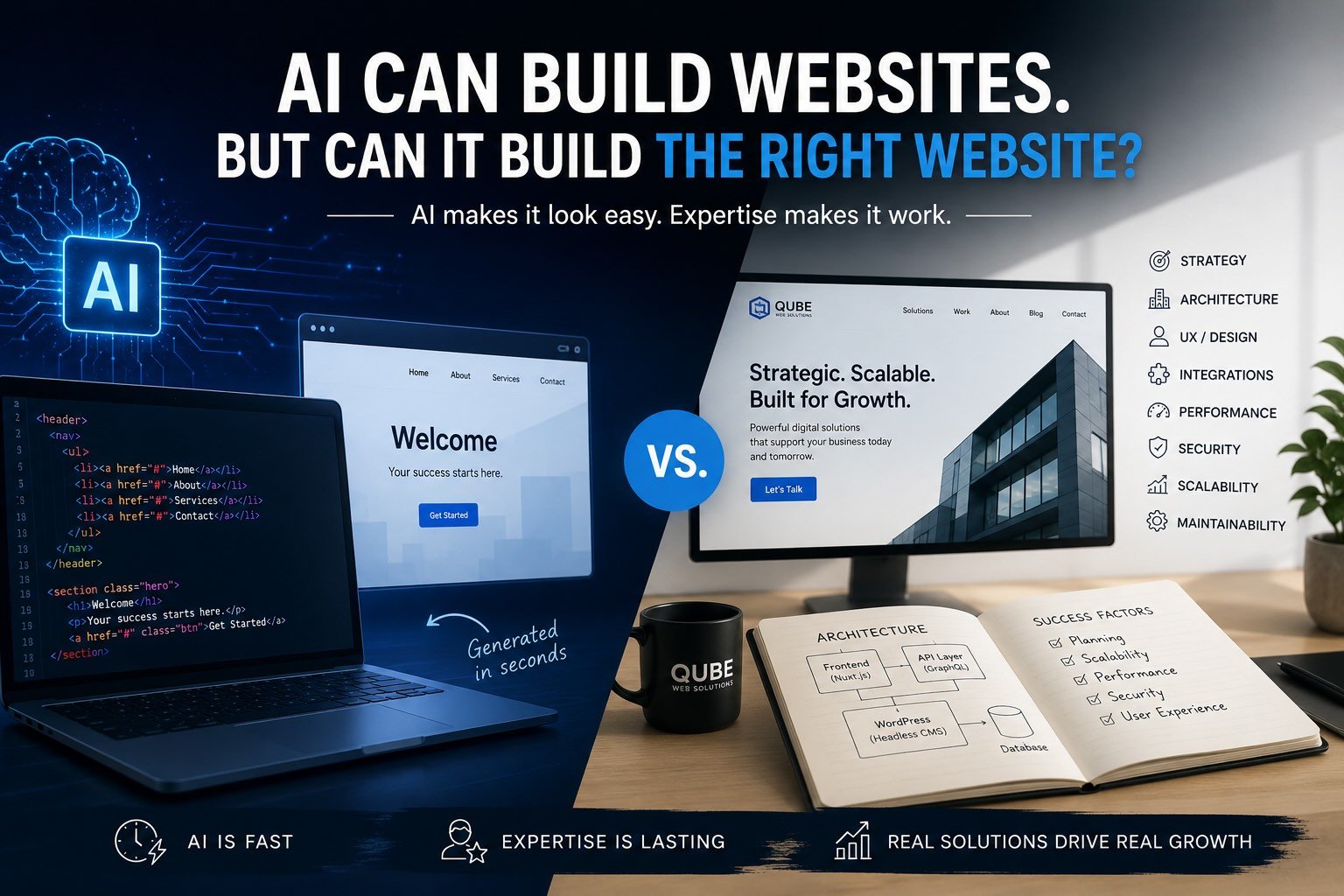
The Rise of AI and “Vibe Coding”
Artificial Intelligence has dramatically changed software development. Today, almost anyone can ask an AI assistant to generate HTML, CSS, JavaScript, or even an entire web application. This has given rise to what many call vibe coding—building software by describing what you want and letting AI generate the code.
At first glance, it feels almost magical.
Need a contact form? AI writes it.
Need a navigation menu? AI generates it.
Need a complete website? AI will happily produce one.
This has led many businesses to believe that professional web development is no longer necessary.
Unfortunately, reality is a little more complicated.
AI Is an Incredible Tool—Not a Replacement for Expertise
Modern AI models are remarkably capable.
They can generate code, explain concepts, suggest improvements, and dramatically accelerate development.
Professional developers use AI every day because it saves time on repetitive tasks and helps explore solutions faster.
The important distinction is this:
Experienced developers know when the AI is right—and when it is wrong.
Without that knowledge, it becomes very difficult to judge whether the generated solution is reliable, secure, scalable, or even technically correct.
The Real Challenge Isn’t Writing Code
Many people assume programming is simply writing code.
In reality, coding is often the smallest part of building a successful website.
The real work happens before the first line of code is written.
A professional website requires:
Business Analysis
Before development begins, someone needs to understand:
- Who are the users?
- What problems are they trying to solve?
- What are the business goals?
- How will success be measured?
AI cannot replace the conversations that define these requirements.
Solution Architecture
Every serious website needs a solid technical foundation.
Questions such as these determine whether a project succeeds in the long term:
- Which technologies should be used?
- Should the site be traditional WordPress or headless?
- Does it require APIs?
- Will it integrate with CRM, ERP, payment providers, or Microsoft 365?
- How will authentication work?
- How will the system scale as the business grows?
These are architectural decisions—not coding tasks.
User Experience (UX)
Visitors decide within seconds whether they trust a website.
Good UX is not created by accident.
It requires understanding user behaviour, accessibility, navigation, information hierarchy, and conversion optimisation.
AI can generate layouts.
Designing an experience that converts visitors into customers is another matter entirely.
Performance
A website that looks impressive but loads slowly loses visitors and search engine rankings.
Performance involves:
- image optimisation
- caching strategies
- lazy loading
- efficient JavaScript
- Core Web Vitals
- server configuration
These are engineering disciplines that AI cannot fully automate.
Security
One of the biggest risks of AI-generated code is security.
A website may appear to work perfectly while containing vulnerabilities that expose customer data or allow attackers to gain access.
Professional developers understand:
- secure authentication
- input validation
- data protection
- permission models
- dependency management
- secure deployment
These topics rarely become visible until something goes wrong.
Long-Term Maintenance
Many AI-generated projects work well initially.
Problems appear six months later when new features are needed.
Without proper architecture, even small changes become expensive and risky.
Professional development focuses on maintainability just as much as functionality.
The “Wall” That Many DIY Projects Hit
Many business owners begin with enthusiasm.
They ask AI to generate a website.
The first pages appear quickly.
Everything seems straightforward.
Then the project grows.
Suddenly they need:
- user accounts
- multilingual support
- payment processing
- booking systems
- CRM integration
- custom business workflows
- SEO optimisation
- analytics
- security
- hosting configuration
- backups
This is usually where the project reaches its limit.
Not because AI failed.
Because the project now requires engineering decisions rather than code generation.
AI Doesn’t Replace Experience—It Amplifies It
One of the greatest strengths of AI is that it amplifies the skills of experienced professionals.
A developer who understands software architecture can use AI to build better solutions faster.
Someone without that background often receives convincing-looking answers that may contain hidden problems.
The difference isn’t the AI.
The difference is knowing how to evaluate its output.
Where AI Truly Shines
At QUBE Web Solutions, AI is part of our daily workflow.
We use it to:
- accelerate development
- explore implementation options
- automate repetitive coding tasks
- improve documentation
- assist with testing
- speed up content production
But every important technical decision is still driven by experience, planning, and proven engineering practices.
The Bottom Line
Artificial Intelligence has made website development more accessible than ever before.
That is genuinely exciting.
However, building a successful website has never been just about writing code.
It is about understanding business requirements, designing the right architecture, integrating technologies, ensuring security, delivering performance, and creating a solution that continues to grow with your business.
AI is an incredibly powerful assistant.
Experience is what turns that assistance into a successful website.
Looking for More Than Just Generated Code?
At QUBE Web Solutions, we combine modern AI-assisted development with years of experience in web architecture, headless WordPress, Vue.js, Nuxt, business system integrations, and custom web applications.
The result isn’t simply a website.
It’s a solution designed to support your business today—and continue supporting it tomorrow.